
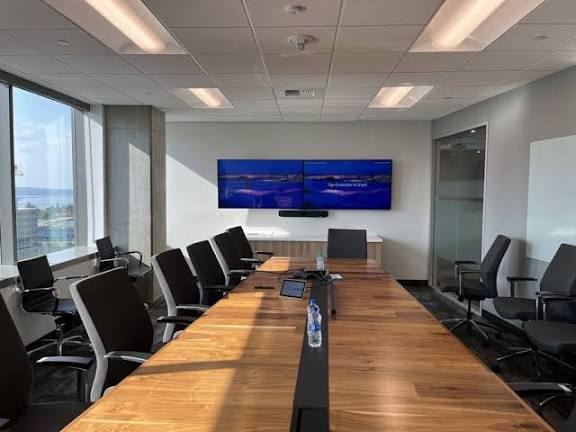
Portland’s commercial spaces present an interesting acoustic challenge. The city’s most desirable office and retail environments are often in buildings that were not designed with audio in mind: converted warehouses with exposed concrete, historic structures with irregular room shapes, modern glass-and-steel buildings that create reflections from every direction. When you add the operational complexity of multi-zone audio requirements across large facilities, you quickly realize that picking speakers out of a catalog is not a plan. It is a gamble.
Planning distributed audio systems in Portland correctly means thinking about the space, the use case, the users, and the operational model before a single component is specified. This guide covers what you should consider before you start.
Why Distributed Audio Is the Right Architecture for Most Portland Businesses
A distributed audio system places multiple smaller speakers throughout a space to deliver even coverage at lower individual volume levels, rather than using one or two high-powered speakers trying to cover the entire area. In Portland’s large commercial spaces, this approach solves the coverage consistency problem that single-point audio systems cannot.
Instead of hot spots near the speakers and dead zones at the perimeter, distributed audio systems in Portland deliver consistent levels across every position in the space. The person at the far end of the open office hears background music at the same comfortable level as the person nearest the speaker. Every seat in the conference room receives the same audio quality from the speakers reinforcing the call.
Acoustic Assessment Comes Before Equipment Selection
Before specifying any component of a distributed audio system in Portland, the acoustic properties of the space should be assessed. Reverb time, background noise levels, and reflection patterns vary dramatically between a carpeted corporate office and a concrete-floored warehouse. These properties determine speaker type, placement density, coverage angles, and whether acoustic treatment is needed alongside the audio system.
Portland AV providers who skip the acoustic assessment are specifying for a generic space, not your specific one. The consequences are predictable: inconsistent coverage, audio quality that varies by location, and adjustments that are expensive to make after installation.
Define Your Zone Requirements First
Most Portland commercial environments need distributed audio to serve multiple zones with different content simultaneously. A lobby, an open office, a cafeteria, and a conference room all have different audio needs at the same time. Zone control is what makes a single distributed audio system serve all of them.
Before you specify any hardware, document which zones exist, what content each zone needs, who controls each zone, and how zone permissions should be structured. These requirements shape both the equipment selection and the system architecture.
Plan for IT Integration
Modern distributed audio systems in Portland are network devices. They connect to the same infrastructure that your IT team manages. VLAN segmentation, remote management access, bandwidth requirements, and security standards should be defined before installation begins.
Long-Term Support and Refresh Planning
A distributed audio system is a long-term investment. Build the support model into the plan from the start. Companies like Projectus design distributed audio systems in Portland with complete documentation and lifecycle planning that protect the investment over time.