
Lice happen. There is no shame in it and no way to avoid it entirely when you have school-age children in a world where head-to-head contact is a daily reality. What you can control is how you treat it. And if you are a parent who takes what goes on your child’s head seriously, the question of non-toxic lice treatment for kids is one that deserves a careful, informed answer. Because the conventional options, while widely available, are not as risk-free as their packaging suggests.
This article is going to give you a genuinely useful, honest breakdown of the best non-toxic lice treatment available today. You will learn why chemical treatments have limitations, what the non-toxic alternatives are and how they work, how to build a complete treatment plan that handles both the hair and the home, and which products have the best track record for safety and effectiveness. Parents who finish reading this will have everything they need to handle lice confidently and without unnecessary chemical exposure.
The Problem With Conventional Lice Shampoos
The two most common active ingredients in over-the-counter lice shampoos are permethrin and pyrethrin. These are insecticides, and they work by targeting the nervous system of the louse. While they are generally considered low-toxicity at recommended concentrations, they are not without concerns, particularly for repeated use in young children.
The American Academy of Pediatrics notes that permethrin should be used with caution in children under two months of age, and pyrethrin products are not recommended for individuals allergic to ragweed or chrysanthemums. More practically, documented resistance to permethrin among lice populations across many US states means these products may not even be effective in your area. This is precisely why non-toxic lice treatment for kids is not just a preference choice but often a strategically smarter one as well.
How Non-Toxic Lice Treatments Work
The most effective non-toxic lice treatment approaches use one of three mechanisms: physical suffocation, enzymatic disruption, or mechanical removal. Each is effective in a different way, and the best protocols use all three in combination.
Enzymatic treatment uses plant-derived enzyme formulas that break down the protein structure of the louse’s exoskeleton and loosen the bond between nits and the hair shaft. Products like Kleen Green Lice Trap Shampoo from trusted companies like Natural Ginesisuse this approach. Because the mechanism is physical rather than chemical, lice cannot develop resistance to it, and it is safe for children of all ages.
Dimethicone (silicone oil) works by coating the louse and blocking its breathing apparatus, causing it to suffocate. Available in several prescription and over-the-counter formulations, dimethicone is recognized as effective and non-toxic, with no known resistance development.
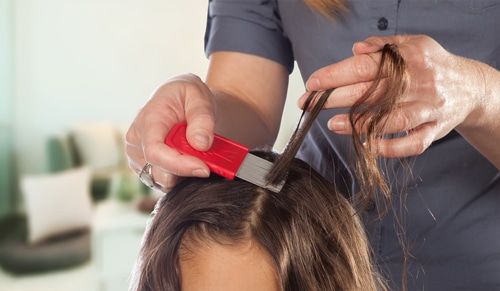
Manual combing is the only method effective at physically removing nits from the hair. No shampoo of any kind, chemical or natural, reliably kills 100 percent of eggs. Combing is non-negotiable for complete elimination and is entirely non-toxic by definition.
The Complete Non-Toxic Lice Treatment Plan For Kids
Here is the most effective step-by-step approach for non-toxic lice treatment for kids:
Step 1: Apply Enzyme Shampoo To Dry Hair
Saturate completely from root to tip. Leave on for 15 minutes. This begins disrupting live lice and softening the nit bond.
Step 2: Apply Locator Spray Under UV Light
After rinsing, apply Neon Nits Locator Spray and scan under UV light to make nits visible. This transforms the combing step from guesswork to precision.
Step 3: Comb Systematically
Using a quality fine-toothed lice comb, work through each hair section from scalp to tip. Wipe the comb on a white cloth after each pass. This is the critical step that removes nits that the shampoo has loosened.
Step 4: Treat The Home Environment
Spray all bedding, pillows, hats, and soft furnishings with Kleen Green. Wash all clothing and towels in hot water. Bag items that cannot be washed for 48 hours.
Step 5: Repeat The Comb-Through In 7 Days
This catches any nymphs that hatched after the initial treatment before they mature and lay eggs.
What Makes A Good Non-Toxic Lice Treatment For Kids
When evaluating products for non-toxic lice treatment for kids, look for formulas that are free from synthetic insecticides, clearly disclose their active ingredients, are hypoallergenic, and have been used safely in children across a range of ages. The best products are also practical: easy to apply, effective at softening nit adhesion to support combing, and available in family-friendly sizes.
Prevention Going Forward
Once you have cleared the infestation using a non-toxic lice treatment for kids protocol, prevention matters. Tie back longer hair during school. Use a mint-based deterrent spray on the hair each morning. Teach children not to share hats or hairbrushes. Check the scalp weekly with a fine comb during any known school outbreaks. And keep your enzyme shampoo stocked so you can act immediately at the first sign of itching.
Non-toxic lice treatment for kids works. It is not a compromise. For families who want effective, evidence-based lice control without putting insecticides on their children’s scalps, enzyme-based products from trusted companies like Natural Ginesis represent the right choice. Confident, informed, and chemical-free.